

Introduction
"Almost everything is online, just one step left." It's the sentence that ends a thousand meetings about public digital services. It's said in good faith, as if digitalization were a percentage. But that step is the service itself. If, to complete a procedure, citizens have to print a form, hand in a certificate or sign at a counter, a single one of these steps is enough: they leave the house, stand in line and lose their morning. Exactly as before. The value of the rest of the digital chain, for them, is zero.
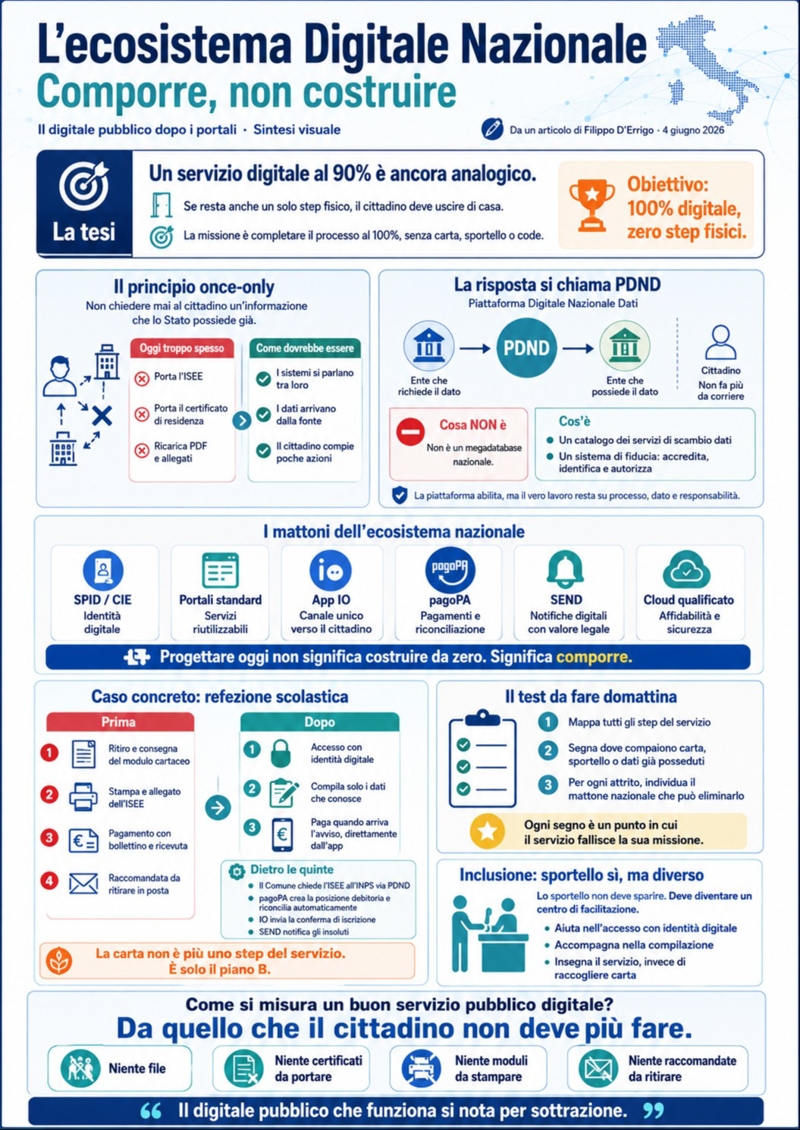
A 90% digital service is an analog service with a website in front of it. The mission of a digital service is not to have a portal. The mission is to let people complete the process 100% without any physical steps. If there is a non-digital step, the service has failed its mission. Not partially. It has failed.
We already know what a service that works looks like
There is a simple way to understand what the standard should be, and you don't need to look for it in manuals. We experience it every day as customers. When we choose a bank, we choose it because we can do everything from home. We open the account online, identity verification happens from the couch, they run the checks, and everything we need is neatly organized in an app. We stay comfortable, and the heavy lifting is invisible.
And the bank is not an exception; it's the rule for the services that satisfy us. Online car insurance no longer asks me for the risk certificate: it retrieves it from the industry database, and the merit class appears on its own. For phone number portability, we provide a single code. The two operators take care of the rest, talking to each other. Switching energy suppliers is handled by the new supplier, cancellation included, and the lights don't go out for even a minute.
The mechanism is always the same. The customer takes a few actions, systems exchange data at the source, and checks happen behind the scenes. A satisfied citizen is built exactly like a satisfied customer. And the good news is that, in the public administration, that mechanism already has a name and an infrastructure.
The once-only principle
Where do you start when designing a citizen-centered service? From a single rule, so simple it seems trivial. Never ask citizens for information the State already has. It's called the once-only principle, and we've been hearing about it for years. It's not a visionary idea. It's an obligation; there are laws that require it. What has changed is something else. Today, for the first time, we have the tools to really implement it.
And yet every day, at thousands of counters and online forms, the State asks citizens to act as couriers between its own databases. Bring the ISEE that INPS has calculated. Bring the residence certificate held by the registry office. Declare data that another office of the same administration has already logged. Every form field that asks for data the State already holds is an analog step disguised as digital. A form that makes you upload the PDF of your ISEE statement is not digitalization. It's paper with a screen in front of it.
The answer is called PDND
To honor once-only, you need a tool. You need a secure, regulated way for an administration to request data from the administration that holds it, instead of from the citizen. That tool exists and it's called the Piattaforma Digitale Nazionale Dati (National Digital Data Platform).
It's worth first saying what the PDND is not, because the misunderstanding is widespread. It is not a giant national database where everyone's data converges. The data stays exactly where it is: at INPS, in the registry offices, at the Agenzia delle Entrate. The PDND is two things. A catalog, where each agency publishes the data-exchange services it makes available. And a trust system, which accredits, identifies and authorizes who can ask for what, from whom and for what purpose. It's the infrastructure that turns "bring the certificate" into "we'll ask whoever has it."
One thing, though, must be said honestly, because this is where the difference between adopting and actually working is decided. The platform enables, but it doesn't replace the dirty work on process, data and administrative responsibility. The bottleneck is rarely the building block. It's the data. Poor-quality data stays poor even when it travels over a perfect channel. And around the data there is the real administrative work. Who is responsible for it. On what legal basis it is exchanged and for what purpose. What happens when the response doesn't arrive, or arrives with a meaning different from the one expected. Who answers for the process from start to finish. Composing the building blocks is the fast part. Putting process, data and responsibility in order is the part no platform can do in place of the agency.
The building blocks are already ready
The PDND is not alone. Through Mission 1 of the PNRR, the country has equipped itself with a complete ecosystem of national platforms. These are the building blocks with which a digital service is built without reinventing anything. Digital identity, SPID and CIE, tells you who you are without making you register for the hundredth time. The services portal is based on standard, reusable templates. The IO app is the single channel through which the State talks to you. pagoPA lets you pay in a standardized way and reconciles on its own, with no manual ticking. SEND delivers notifications with legal value without a trip to the post office. The qualified cloud runs everything with adequate standards of reliability and security.
Designing a digital service today doesn't mean building. It means composing. Each of these building blocks has had a dedicated funding measure, designed so that agencies adopt them and line them up. Whoever reinvents pieces that already exist pays twice and integrates nothing.
The concrete case of school meals
Let's take a real service, one that touches families every year. School meals. I'm not telling this from hearsay. It's a path I've experienced firsthand while supporting agencies in implementing the measures, from the flow drawn on paper to the service in production. I know where it creates friction and where, once well composed, it flows.
And the friction exists, it must be said, because the "after" doesn't arrive by decree. Often the agency's management system is closed. It doesn't expose APIs, and when it does, each connector is paid for separately. Often the data is dirty. There are years of manual entries to clean up before they can be exchanged. And often people fear change. Those who work on the old process defend it because it's what they are accountable for. It's not laziness, it's prudence. Until someone accompanies them toward the new, it's normal for them to defend the old.
This is the dirty work. Process, data, responsibility. You work through it, one service at a time. I've seen it done.
The before is something we all know. You pick up a paper form and hand it back filled out. You print the ISEE statement and attach it. You pay a bill slip and keep the receipt, to show if requested. And when a payment is missed, a registered letter arrives, to be collected at the post office. The parent acts as courier, cashier and State archive.
The after is told by counting the citizen's actions, because the count is the interesting part. The first is logging in with digital identity on the municipality's portal. The second is filling out the form with only the information that only they know: which child, which school, any special needs. The third is paying when the notice arrives, directly from the app.
Three actions. Everything else is done by the systems among themselves. The municipality requests the ISEE from INPS through the PDND. The data comes from whoever calculates it, certified at the source, and never passes through the parent's hands. The payment position is created on pagoPA, and when payment is made the reconciliation is automatic, with no clerk ticking off bank transfers. The enrollment confirmation arrives as a message on IO. And if an installment remains unpaid, the notification goes out via SEND, digital and with legal value.
And here is a detail worth pausing on, because it's the sign that something has truly changed. In the redesigned process, the paper letter survives only as a fallback, if the digital notification fails. Paper is no longer a step of the service. It's the emergency procedure. For a century, the registered letter was the ordinary channel through which the State spoke to citizens. Today it has been demoted to plan B.
Same service, same law, same municipality. Opposite experience. And none of the technologies involved is exotic or experimental. They are the national building blocks, composed in the right order.
The test every administration can run tomorrow morning
From this case we can derive a test that can be applied at almost zero cost, on Monday morning, to any service catalog.
Take a service. List all the steps of the process, from first contact to case closure, including those you can't see from the portal, such as document delivery, payment, communication of outcomes, reminders. Mark every step that requires paper, a counter visit, or data the State already holds.
Every mark is a point where the service fails its mission. And it's also, on the positive side, the to-do list. For almost every mark, a national building block that eliminates it already exists.
And what about those who don't use digital?
The objection arrives right on cue, and it's legitimate. Doesn't a 100% digital process risk leaving behind those who don't use digital? The answer is yes, if you think that digitalizing a service means closing the counter. And it's no, if the counter changes its mission.
For the residual share of citizens who don't use digital tools, the counter must not disappear. It must turn into a facilitation center. It's no longer the place where you hand in paper. It's the place where someone helps you use the digital service, guides you through logging in with your digital identity, fills out the form with you, shows you how it's done, until you can do it on your own. The operator moves to the other side of the glass. They no longer sit in front of the citizen processing forms; they sit beside the citizen teaching them the way.
The distinction is subtle but it decides everything. There remains only one process, 100% digital. What changes is access, which can be assisted. The paper step disappears from the service, and human help moves alongside those who need it. And there is a valuable side effect. Platforms now do the work of transcription, registration and reconciliation on their own, and counters finally have the time to do what machines can't, which is to be there for people.
What citizens no longer have to do
A citizen-centered service isn't measured by how beautiful the portal is, or by how many services appear in the catalog. It's measured by what citizens no longer have to do. The lines they don't stand in, the certificates they don't bring, the forms they don't print, the registered letters they don't pick up.
Public digital services that work are noticed by subtraction. Everything else is a facade with a screen.
The national ecosystem is the part of the work already done. The platforms are there, the rules are there, the funding has been there. The part that remains is played out agency by agency, service by service, and it's the most concrete of all. Taking the building blocks and composing them, until the last paper step disappears from the process.
On that day, citizens won't notice a thing. No ribbon to cut, no inauguration, just a line that's no longer there. And that's exactly how you recognize public digital services done right.