

Hey Hay Dama
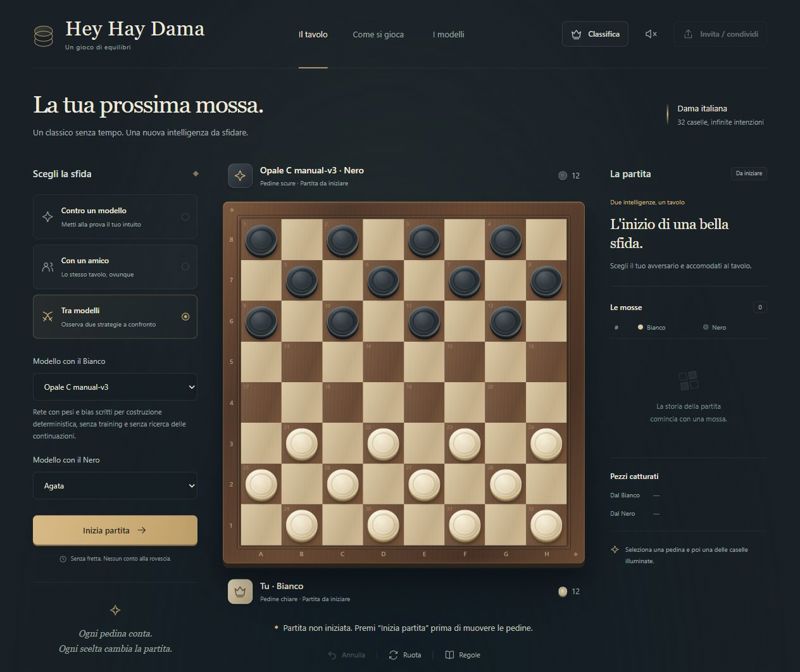
On Hey Hay Dama you can play Italian draughts and watch a match between two engines. The experiment starts from a question: what decisions do three agents make when they have to design a player on their own, and which ones do they revise when they can discuss with each other?
Three agents, six engines
| Agent | First engine | Search engine |
|---|---|---|
| Kimi K3.1 | Klinamite | Diaspro |
| Claude Opus 5.5 | Agata | Avventurina |
| Codex (GPT-6 Astra) | Opale | Ametista |
How the test unfolded
Each agent built an engine that evaluated positions after a legal move. Afterward, the three discussed in a shared file, exchanging objections and test positions. For example, two capture paths can threaten the same piece: Codex proposed a way to count it only once, and Kimi adopted it. Each agent retained control of its own code and weights.
To verify the changes, the agents froze the versions, recorded the games, and set aside distinct openings for confirmation. In the internal tournament, 294 games were started. The 289 that were completed awarded two points for a win and one for a draw. The five that were interrupted awarded no points. Agata v9 totaled 229 points, Opale C v3 187, and Klinamite v3 162.
The comparison with Kingsrow Italian 1.19e
The three engines faced Kingsrow on nine openings, each played first with one color and then with the other. Kingsrow won all 54 matches, 18 against each engine. Once searching continuations was authorized, the agents developed three new engines and put them through separate tests.
| Version vs. Kingsrow | Games | Wins | Draws | Losses |
|---|---|---|---|---|
| Diaspro v12 | 54 | 0 | 1 | 53 |
| Avventurina a7 | 36 | 2 | 11 | 23 |
| Ametista v14 | 36 | 3 | 4 | 29 |
Openings, sample sizes, and operating conditions differ across the three tests. The logs document which ideas passed from one agent to another. To measure how much the collaboration affected playing strength, we would also need an equivalent control group working without communicating.
The report on GitHub collects the original discussions, protocols, game records, and audits.


